ART · BELIEF · THE CONDITIONS OF FREEDOM
Franz
Marc
Religion, Art,
and Modern Europe
Franz Marc’s search for spiritual renewal shaped his painting, his friendships, and his hopes for war. This biography reverses the direction of a central scholarly judgment: where the artist Maria Franck-Marc’s objections have been judged inadequate to her husband’s philosophy, Liana Marie Sive asks whether his philosophy can withstand her objections. It then follows what his concessions changed, whose work and money sustained his artistic freedom, and how the editing of his letters shaped the Marc later readers inherited.
English and German manuscripts · Private review access
Four claims
that change
how Marc is read.
1. Maria’s objection tests Franz’s philosophy. Sive argues that her refusal of purification through evil exposes a gap in his justification of war: a gain from suffering does not make the violence that caused it necessary or good.
“There can be no purifying effect through something evil.”
2. Franz’s concessions had limits. He accepted artistic criticism and declared that he would withdraw an essay, yet continued to defend the war. The biography distinguishes changes in his thinking, promises of action, and evidence that publication actually changed.
3. Artistic freedom rested on unequal conditions. Koehler’s advances, Maria’s manuscript work, and delayed payments for Yellow Cow reveal whose time and resources sustained his work—and who bore the uncertainty.
4. Editions helped construct his legacy. The 1920 letters omitted a proposed sale price and his monthly pay while retaining a contemplated gift of 100 marks. Such omissions changed what readers could know about the life behind the ideas.
Katja Förster had already distinguished artistic concession from a continuing defense of war. Sive’s disagreement concerns her assessment of Maria’s criticism: its force must be judged by the objection it raises, not by how completely it reconstructs Franz’s system.
Read the four claims, the scholarly disagreement, and the evidenceTHE WHOLE LIFE
The painter, his world, and his afterlife.
At seventeen, Marc planned to become a pastor. His father was a painter; his mother’s religious convictions helped shape the household. His portraits of them, painted in 1902, open a history of faith, family, and the choice of a vocation.
The biography follows his observation of animals, his experiments with color, and his increasingly abstract compositions. In 1912, he and Wassily Kandinsky published Der Blaue Reiter (The Blue Rider). Friendships with August Macke and Paul Klee, dealings with publishers and collectors, and the home at Ried place the celebrated paintings within a working life.
War interrupted that life; Marc died in 1916. The story continues through Maria’s care for his work and her own development as a weaver. In 1952, eleven of her woven works were exhibited alongside drawings from his last sketchbook. The later chapters follow the editions, collections, and political uses through which successive generations came to know him.
Read the intellectual manifesto ↗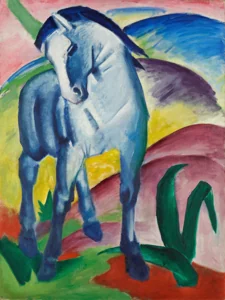
THE PAINTINGS
The painting can complicate the theory.
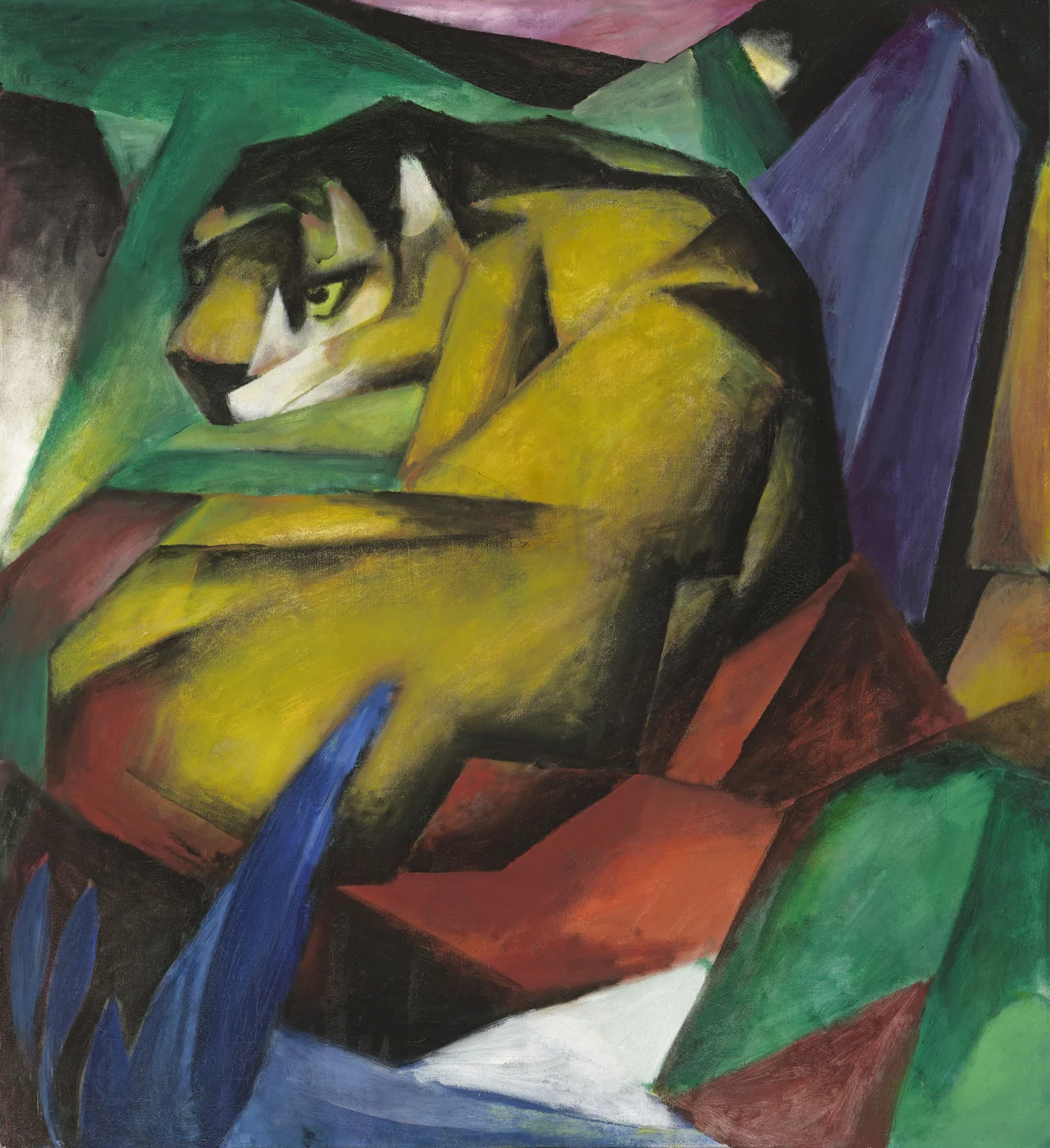
In Tiger, the animal’s weight and the competing directions of color coexist. Close looking reveals decisions that Marc’s declarations of spiritual purpose cannot explain on their own.
Art as evidence ↗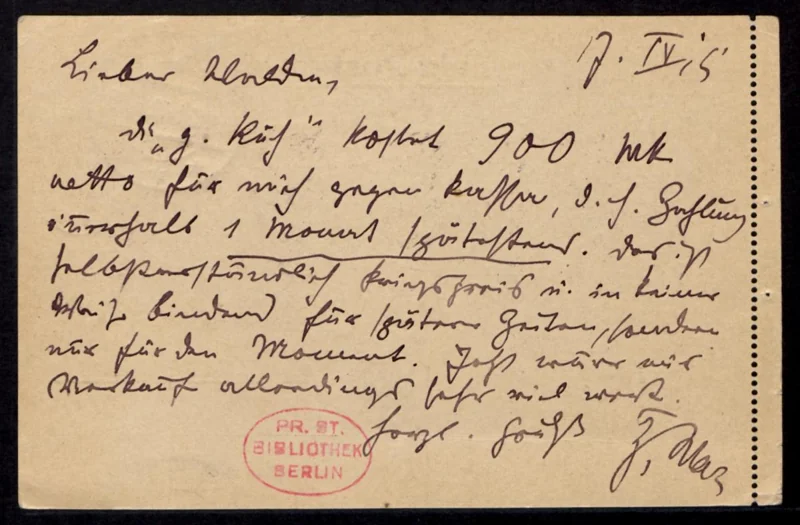
THE CORRESPONDENCE
An objection became a demand about publication.
Maria wanted an essay withheld. On April 7, 1915, Franz declared that he would withdraw “II.” The missing next instruction matters: what did an editor actually receive, and what happened to the text?
Letters and judgment ↗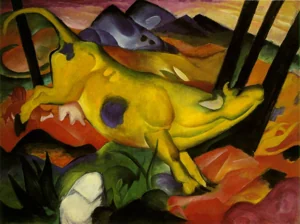
THE WORKING LIFE
A sale could still leave the household waiting.
In April 1915, Marc asked 900 marks for Yellow Cow, payable within a month. In May he conditionally accepted installments. By July and August, the correspondence was asking for overdue payments.
The conditions of work ↗A PASSAGE FROM THE BOOK
Begin with
a painted surface.
“The tiger has room to turn and almost nowhere to go. Its body folds across a canvas a little more than a meter high. The haunch swells toward the right; the head faces left. A yellow shoulder rises between them, thickly bounded by black.”
- Find the opposing directions. The body extends right while the head faces left. The description asks the reader to look at a specific construction, rather than accept a general label such as “spiritual art.”
- Follow the work across chapters. The animal studies, experiments with color, and movement toward abstraction show how Marc arrived at such decisions. His writings and friendships give those experiments a history.
Read the annotated painting example ↗
Explore the two editionsFOR SCHOLARS, AGENTS, & PUBLISHERS
A whole life in art.
A new account of what sustained it.
The completed English and German manuscripts follow Marc from his religious upbringing through the Blue Rider and the war to his posthumous reputation. Paintings, letters, payment records, and editions carry the argument. Illustrations, source notes, worked mathematical examples, and a computational companion support close examination.